Where we
operate

Soundclaims has a robust presence across Africa, including:

  • North Africa: Algeria, Egypt, Morocco, Tunisia
  • West Africa: Benin, Burkina Faso, Cape Verde, Gambia, Ghana, Guinea, Ivory Coast, Mali, Mauritania, Nigeria, Senegal, Sierra Leone, Togo
  • Central Africa: Cameroon, Central African Republic, Chad, Congo DRC, Republic of the Congo, Gabon, Niger
  • East Africa: Burundi, Djibouti, Ethiopia, Kenya, Malawi, Mozambique, Rwanda, Sudan, Tanzania, Uganda
  • Southern Africa: Angola, Botswana, Madagascar, Mauritius, Namibia, South Africa, Zambia, Zimbabwe

* Select a country for more information
Algeria
  • Official Name: People's Democratic Republic of Algeria
  • Currency: ALGERIAN DINAR (DZD)
  • Population: 46,814,308
  • Official Name: People's Democratic Republic of Algeria+
  • Currency: ALGERIAN DINAR (DZD)++
  • Population: 46,814,308+++

Algeria's legal system is a mixed system that combines French civil law with Islamic law. The country's laws are based on its constitution, laws, and international treaties, and its legal framework has developed since its independence in 1962. While the system is largely based on French civil law, elements of Sharia (Islamic law) are also present, particularly in areas related to personal status.

Algeria is expected to maintain sovereign payment reliability due to low external debt exposure and hydrocarbon revenues. However, domestic contractors and foreign suppliers in non-strategic sectors may encounter delayed settlements due to tighter banking controls and import domiciliation requirements. Fiscal pressures will likely persist as deficits widen, but outright default remains improbable. Payment risks will therefore remain concentrated at the operational level rather than at sovereign obligations, reflecting Algeria’s prioritisation of external credibility while deferring non-priority domestic commitments.

Foreign-exchange controls will likely remain stringent, with July 2025 procedures reinforcing documentary requirements and restricting retail allowances. Import domiciliation rules are expected to prolong delays for trade payments, limiting convertibility for non-strategic sectors. The black-market premium on foreign currency will likely persist, underscoring ongoing scarcity in official channels. Participation in regional payment systems may gradually ease intra-African transactions; however, broader convertibility constraints are expected to persist. Profit repatriation and import-dependent businesses will remain vulnerable to operational delays over the forecast period.

Angola
  • Official Name: Republic of Angola
  • Currency: ANGOLAN KWANZA (AOA)
  • Population: 37,885,849
  • Official Name: Republic of Angola+
  • Currency: ANGOLAN KWANZA (AOA)++
  • Population: 37,885,849+++

Angola's legal system is a civil law system rooted in Portuguese law, with legislation as the primary source of law. Its legal framework is defined by the Constitution of 2010, which outlines the structure of a multiparty democracy with a presidential regime and guarantees the separation of powers. Customary law also plays a role in local communities, though its application must not contradict the Constitution or threaten human dignity.

Non-payment risks remain elevated despite plans to reduce the public debt-to-GDP ratio. Debt servicing will absorb two-thirds of revenue, with most payments due externally. Dollar-denominated obligations expose Angola to exchange rate volatility, while an oil price slump in early 2025 triggered a USD 200 million margin call on a loan from JPMorgan, which has since been reclaimed. The government is likely to settle its maturing Eurobond in November, although non-payment risks will remain elevated amid liquidity constraints.

Despite efforts to improve liquidity, foreign currency shortages frequently impact businesses operating in the country. As a result, the remittances of funds abroad from Angola can take up to three months. The availability of currency in the domestic market is closely related to the fluctuation in oil export revenues. With the depreciation of the kwanza, authorities have stepped up restrictions on the foreign exchange trade, including tightening the band in which commercial traders can buy dollars.

Benin
  • Official Name: Republic of Benin
  • Currency: WEST AFRICAN CFA FRANC (XOF)
  • Population: 14,462,724
  • Official Name: Republic of Benin+
  • Currency: WEST AFRICAN CFA FRANC (XOF)++
  • Population: 14,462,724+++

Benin's legal system is a hybrid of French civil law and customary law, with its framework based on a written constitution and various codes. The legal system is structured with multiple tiers of courts and faces challenges with transparency and resources. Key legal areas include the Constitution, which outlines citizen rights, and regional integration laws from bodies like the WAEMU and OHADA.

Proactive debt management and a strong economic outlook mitigate non-payment risks. Tax revenues have been above target, while IMF credit has supported the balance of payments. The government has implemented a strategy of refinancing external debt to moderate debt servicing costs in the near-term. However, vulnerability to external shocks will persist, including the border closure with Niger, which has impacted the trade and transport sectors, as well as energy subsidy reform in Nigeria, which increased Beninese oil prices.

Currency Inconvertibility: Benin’s use of the CFA Franc currency offers France’s guarantee of convertibility, fixed parities with the euro, free transferability, and the centralisation of foreign exchange reserves. Benin has adopted the currency control regulations of the West African Economic and Monetary Union (WAEMU). As such, while there are no limits on inward transfers, restrictions apply on outward foreign currency transfers, with some classes of transactions subject to authorisation requirements.

Botswana
  • Official Name: Republic of Botswana
  • Currency: BOTSWANA PULA (BWP)
  • Population: 2,521,139
  • Official Name: Republic of Botswana+
  • Currency: BOTSWANA PULA (BWP)++
  • Population: 2,521,139+++

Botswana's legal system is a stable hybrid of Roman-Dutch common law, English common law, and customary law. Its legal framework is defined by the Constitution of Botswana, which guarantees fundamental rights and freedoms and establishes the separation of powers between the executive, legislative, and judicial branches.

Botswana has maintained a low debt-to-GDP ratio, recorded at about 25 percent in 2024, which has mitigated non-payment risks. The government continues to demonstrate a commitment to prudent fiscal management by reducing fiscal spending while facing external headwinds and maintaining sufficient reserves. While there has been a major drop in government income amid a downturn in global demand for diamonds, which account for over two-thirds of export revenue, the country’s debt management is unlikely to substantially deteriorate over the coming year.

There are no significant foreign exchange controls in Botswana, and policies generally allow investors to repatriate profits and capital with minimal restrictions. Authorities continue to maintain sufficient foreign exchange reserves, supporting liquidity in the domestic market and, subsequently, currency convertibility. Foreign exchange reserves stood at over 5 months of import cover in February 2025. However, the drop in diamond export revenues will place pressure on the reserve position over the coming year, which may impact foreign currency availability.

Burkina Faso
  • Official Name: Burkina Faso
  • Currency: WEST AFRICAN CFA FRANC (XOF)
  • Population: 23,548,781
  • Official Name: Burkina Faso+
  • Currency: WEST AFRICAN CFA FRANC (XOF)++
  • Population: 23,548,781+++

Burkina Faso has a civil law system based on the French model, combined with customary law. The legal system includes a constitution, transitional charters, administrative acts, and international agreements, with a court system that includes lawyers (Avocats) and notaries (Notaires). However, legal challenges persist due to security issues, and customary and traditional authorities also play a significant role in the justice system for many citizens.

The administration’s fiscal constraints, exacerbated by declining gold output and security-related spending, increase the risk of payment delays for government contractors and state-backed projects. While external debt remains high, liquidity challenges could affect the government’s ability to meet financial obligations. Reports of delayed public sector salaries and increased domestic borrowing suggest potential short-term financial distress.

The CFA franc remains stable due to its peg to the euro, but political uncertainty and potential regional isolation could trigger restrictions on capital transfers. The government’s economic realignment, including increased financial ties with China and Russia, may complicate access to foreign exchange. While no formal capital controls are in place, prolonged instability could increase risks related to currency access and financial transactions.

Burundi
  • Official Name: Republic of Burundi
  • Currency: BURUNDIAN FRANC (BIF)
  • Population: 14,047,786
  • Official Name: Republic of Burundi+
  • Currency: BURUNDIAN FRANC (BIF)++
  • Population: 14,047,786+++

Burundi's legal system is a hybrid of Belgian civil law and customary law, but its functionality is severely hampered by extensive government interference, corruption, and political instability. The 2018 Constitution provides a legal framework, yet human rights abuses and a lack of judicial independence are widespread.

Burundi's debt situation is tenuous, with public debt estimated at 42.3 percent of GDP in June 2025. While faced with rising debt repayments and revenue shortfalls, persistent budgetary deficits will leave the government reliant on external funding. Despite renewed donor engagement in recent years, the government’s increased reliance on high-interest domestic debt and inability to mobilise domestic revenue continue to drive non-payment risks.

Burundi continues to face foreign exchange shortages, driving CINT risks in the country. According to the latest available data, the government’s reserves stood at 1.4 months of import cover in early 2025. While authorities recently lifted foreign exchange capital controls to stimulate liquidity in the domestic market, delays in receiving foreign currency and repatriating profits persist. The anticipated loss of foreign exchange inflows from revenue for regional peacekeeping efforts will exacerbate CINT risks in the coming months.

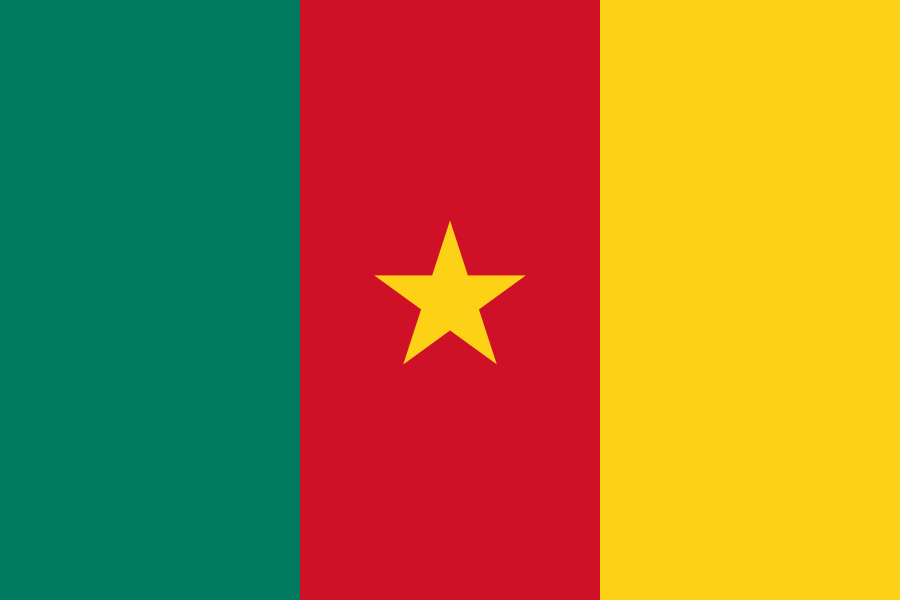
Cameroon
  • Official Name: Republic of Cameroon
  • Currency: CENTRAL AFRICAN CFA FRANC (XAF)
  • Population: 29,123,744
  • Official Name: Republic of Cameroon+
  • Currency: CENTRAL AFRICAN CFA FRANC (XAF)++
  • Population: 29,123,744+++

Cameroon's legal system is a unique hybrid of French civil law and English common law, a product of its colonial history. This dual system exists alongside customary law and is a source of tension, particularly in the English-speaking regions. The country's legal landscape is further shaped by its membership in regional bodies like the Organization for the Harmonization of Business Law in Africa (OHADA).

The risk of non-payment is again rising in Cameroon, as the government faces falling oil and gas revenues and rising debt servicing costs. In the absence of continued IMF support, the government has had to address the budget deficit by increasing borrowing, including through commercial banks. Difficulties in accessing regional credit markets have forced a growing reliance on external debt, worsening exposure to currency fluctuations. The government has explicitly prioritised the repayment of external loans, sustaining non-payment risks related to domestic arrears.

Cameroon’s use of the CFA Franc currency offers France’s guarantee of convertibility, fixed parities with the euro, free transferability, and the centralisation of foreign exchange reserves. However, under regional BEAC restrictions, outward transactions over a certain amount will trigger an advance reporting and documentation requirement, which reportedly results in delays. Another major drop in oil prices will likely prompt the imposition of further restrictive measures across the CEMAC region.

Cape Verde
  • Official Name: Republic of Cabo Verde
  • Currency: CAPE VERDEAN ESCUDO (CVE)
  • Population: 524,877
  • Official Name: Republic of Cabo Verde+
  • Currency: CAPE VERDEAN ESCUDO (CVE)++
  • Population: 524,877+++

The legal system of Cape Verde (Cabo Verde) is a parliamentary representative democratic republic with a framework largely modeled on the Portuguese system. The country’s legal framework has been modernized to attract investment, but some challenges remain due to an overburdened judicial system.

Cape Verde continues to make fiscal consolidation progress, and rising tourism revenues, sustained inflows of foreign direct investment, and fiscal support from multilateral institutions, will enable the government to meet its debt obligations. However, the country’s fiscal position remains vulnerable to external shocks, particularly global fuel price surges. As such, with total public debt at over 100 percent of GDP, non-payment risk will remain prominent.

Cape Verde’s escudo is pegged to the euro at a fixed rate under the Credit Facility Contract between Cape Verde and Portugal. Over the past year, Cape Verdean monetary authorities have shown a positive commitment to preserving the currency peg by reducing the differential between local interest rates and that of the European Central Bank. This is likely to continue, keeping currency convertibility risks low in Cape Verde.

Central African Republic
  • Official Name: Central African Republic
  • Currency: CENTRAL AFRICAN CFA FRANC (XAF)
  • Population: 5,330,690
  • Official Name: Central African Republic+
  • Currency: CENTRAL AFRICAN CFA FRANC (XAF)++
  • Population: 5,330,690+++

The legal system of the Central African Republic (CAR) is a hybrid of French civil law and customary law. However, decades of political instability and violent conflict have devastated the judicial system, leading to widespread impunity and severely limited access to justice for the majority of the population. While the legal framework formally guarantees fundamental rights, there is a significant disconnect between legal provisions and practical reality.

The government faces growing fiscal difficulties amid falling external donor support, a drop in foreign investment, and weak revenue mobilisation capacity. Revenue mobilisation is projected to increase marginally into 2025 as the government passes new tax reforms. However, the budget will remain almost completely dependent on international aid. There is a rising likelihood that the IMF will suspend budgetary support this year, which would precipitate a further increase in non-payment risks.

CAR’s use of the CFA Franc currency offers France’s guarantee of convertibility, fixed parities with the euro, free transferability, and the centralisation of foreign exchange reserves. However, under regional BEAC restrictions, outward transactions over a certain amount will trigger an advance reporting and documentation requirement, which reportedly results in delays. Another fall in regional foreign exchange reserves, likely triggered by low oil prices, will raise the risk of tighter forex restrictions.

Chad
  • Official Name: Republic of Chad
  • Currency: CENTRAL AFRICAN CFA FRANC (XAF)
  • Population: 20,299,123
  • Official Name: Republic of Chad+
  • Currency: CENTRAL AFRICAN CFA FRANC (XAF)++
  • Population: 20,299,123+++

Chad's legal system is a hybrid of French civil law and customary law, though a long history of political instability has weakened judicial independence and rule of law. Following a series of transitional governments, a new constitution was adopted in December 2023, establishing the Fifth Republic.

The risk of non-payment will remain heightened for the coming year, as Chad’s economy remains highly vulnerable to global oil price fluctuations. While the signing of a debt restructuring agreement with private creditors in late 2022 has allowed for the resumption of international development support, the external debt burden remains high. A new IMF financing arrangement in mid-2025 will partially mitigate non-payment risks in the near-term, but plans to take on additional debt to finance an ambitious development plan will raise longer-term risks.

Chad’s use of the CFA Franc currency offers France’s guarantee of convertibility, fixed parities with the euro, free transferability, and the centralisation of foreign exchange reserves. However, under regional BEAC restrictions, outward transactions over a certain amount will trigger an advance reporting and documentation requirement, which reportedly results in delays. Another major drop in oil prices will likely prompt the imposition of further restrictive measures.

Democratic Republic of the Congo
  • Official Name: Democratic Republic of the Congo
  • Currency: CONGOLESE FRANC (CDF)
  • Population: 109,276,265
  • Official Name: Democratic Republic of the Congo+
  • Currency: CONGOLESE FRANC (CDF)++
  • Population: 109,276,265+++

The legal system of the Democratic Republic of the Congo (DRC) is a mixed system influenced by Belgian civil law and customary law. Despite having constitutional guarantees for a separation of powers, the judiciary's effectiveness is undermined by weak institutional capacity, corruption, and political interference.

A widening public deficit due to increased spending needs, coupled with limited revenue growth outside of the mining sector, will sustain the risk of non-payment or delayed payments into the coming year. However, the DRC is likely to receive sustained external support from development partners, including the USD 2.7 billion worth of loan agreements from the IMF approved in 2025. This, alongside a high proportion of concessional debt and a debt-to-GDP ratio below 25 percent, significantly reduces the risk of a default event.

The DRC imposes restrictions on the movement of foreign currency across its borders, although US dollars are widely used for in-country transactions. The recent recovery of mineral prices, alongside renewed government efforts to combat the dollarisation of the economy, will likely slow the depreciation of the Congolese franc and limit foreign exchange shortages in the coming year. This, in turn, will support the ongoing recovery of foreign exchange reserves.

Djibouti
  • Official Name: Republic of Djibouti
  • Currency: DJIBOUTIAN FRANC (DJF)
  • Population: 1,168,722
  • Official Name: Republic of Djibouti+
  • Currency: DJIBOUTIAN FRANC (DJF)++
  • Population: 1,168,722+++

Djibouti's legal system is a hybrid of French civil law, Islamic law (Sharia), and customary law. While the 1992 Constitution provides for an independent judiciary, executive influence and corruption significantly undermine the rule of law.

Djibouti’s high external debt levels elevate the risks of delayed payments or defaults. Ongoing debt renegotiations, particularly with Chinese creditors, are critical to avoiding fiscal crises. Declining port revenues further strain Djibouti’s financial position, while rising servicing costs exacerbate the challenge. Arrears have surpassed 6 percent of GDP, and reserve shortfalls threaten the sustainability of repayment schedules into 2025. Additional defaults or restructuring efforts may occur if economic pressures persist or external creditors demand stricter terms.

While Djibouti’s pegged exchange rate to the US dollar mitigates immediate currency risks, declining foreign reserves and rising external obligations increase the potential for informal restrictions. As of Q1 2025, reserve coverage stood below 75 percent of the money supply, weakening the currency board’s resilience. The government’s reliance on external debt payments heightens the risks of disruptions to international transactions, impacting investor confidence and operational liquidity for businesses reliant on cross-border trade.

Egypt
  • Official Name: Arab Republic of Egypt
  • Currency: EGYPTIAN POUND (EGP)
  • Population: 116,538,258
  • Official Name: Arab Republic of Egypt+
  • Currency: EGYPTIAN POUND (EGP)++
  • Population: 116,538,258+++

Egypt's legal system is a hybrid that combines the French Napoleonic Code with Islamic Sharia law and has influences from other legal traditions. It is a civil law system with codified laws, where the constitution is the supreme law, followed by laws passed by parliament, presidential decrees, and other regulations. Islamic Sharia is the principal source for legislation concerning personal status issues like marriage and inheritance for Muslims.

Egypt is expected to meet 2026 debt obligations through a mix of international issuance, privatisation inflows, and multilateral financing. However, elevated refinancing requirements and uneven revenue recovery will sustain pressure on repayment capacity. Delays in revenue from energy exports and trade-related services may necessitate short-term rollover arrangements. While default is not anticipated, liquidity fragility and tightening credit conditions could heighten the probability of restructuring or payment deferrals should market access weaken.

Limited barriers to capital transfers are expected to persist through systemic inefficiencies rather than formal prohibitions. Companies will likely continue facing delays in processing cross-border payments due to banking sector bottlenecks and shortages of hard currency. Reliance on informal exchange channels is expected to remain common as depreciation pressures continue to sustain market volatility. If foreign reserves weaken, the state may reintroduce administrative rationing or extend prioritisation measures, even in the absence of renewed formal capital controls.

Ethiopia
  • Official Name: Federal Democratic Republic of Ethiopia
  • Currency: ETHIOPIAN BIRR (ETB)
  • Population: 132,059,767
  • Official Name: Federal Democratic Republic of Ethiopia+
  • Currency: ETHIOPIAN BIRR (ETB)++
  • Population: 132,059,767+++

Ethiopia has a mixed legal system, combining elements of French-inspired civil law with aspects of common law and customary law. Its legal framework is defined by the federal structure outlined in the 1995 Constitution. This federal system features separate court structures at the national and state levels.

The government will remain in selective default until the private-creditor restructuring is concluded. Bilateral relief will sustain near-term liquidity, but extended negotiations will prolong arrears. IMF financing will cover essential imports; however, inflation and currency weakness will put pressure on repayment capacity. Domestic arrears to suppliers will persist due to delayed fiscal transfers. External payment performance will depend on timely restructuring outcomes, leaving overall non-payment risk elevated across the next twelve months.

The managed float system will preserve partial exchange-rate stability but maintain segmentation between formal and parallel markets. Foreign exchange shortages will continue to constrain conversion and transfers for importers and investors. Repatriation delays will remain common, extending beyond ninety days for most non-priority transactions. Administrative reforms will improve transparency, but not liquidity availability. Reserve levels will remain weak, sustaining inconvertibility and transfer constraints through the one-year outlook period.

Gabon
  • Official Name: Gabonese Republic
  • Currency: CENTRAL AFRICAN CFA FRANC (XAF)
  • Population: 2,538,952
  • Official Name: Gabonese Republic+
  • Currency: CENTRAL AFRICAN CFA FRANC (XAF)++
  • Population: 2,538,952+++

The legal system of Gabon is a mixed system, primarily based on French civil law but also incorporating traditional customary law. Recent political changes, including a 2023 military coup and the subsequent approval of a new constitution in 2024, have significantly reshaped the country's legal landscape.

The government’s ability to meet its financial commitments has decreased substantially since the 2023 coup, as public finances have become increasingly strained by an ambitious public expenditure programme and the rollout of major infrastructure investment projects. The World Bank ceased disbursements to the country twice in 2024 due to the accumulation of debt arrears worth billions of US dollars. The government recently averted default risks through regional and international buybacks of a Eurobond, which was set to mature in June 2025.

While intermittent foreign exchange shortages have been a long-standing issue in the CEMAC region, Gabon's foreign currency reserves have improved substantially in recent years due to increased oil exports and the implementation of regional restrictions on cross-border currency movements. However, while Gabon now essentially has the capacity to meet transfer requirements, BEAC regulations remain in place, hindering cross-border monetary transfers. With most transfers now subject to high-level government approval, foreign companies report that transactions often take months to clear.

Gambia
  • Official Name: Republic of the Gambia
  • Currency: DALASI (GMD)
  • Population: 2,759,988
  • Official Name: Republic of the Gambia+
  • Currency: DALASI (GMD)++
  • Population: 2,759,988+++

The legal system of The Gambia is a mixed, or tripartite, system that combines English common law, customary law, and Islamic (Shari'a) law. Since emerging from a long period of authoritarian rule in 2017, the country has been undertaking a democratic transition with legal and judicial reforms.

Despite a positive economic outlook, fiscal pressures are likely to remain heightened in the coming year, as the government attempts to manage a growing debt servicing burden following the expiration of debt deferrals with multiple creditors. Government reforms have been successful in raising revenue collection, although this has been insufficient to balance rising expenditure. Nonetheless, sustained support from external development partners will constrain non-payment risks in the near-term. Non-payment risks in the energy sector have also been reduced by the ending of a burdensome supply contract.

Gambia has no restrictions in place on foreign currency transfers or repatriation of profits by foreign companies. Foreign exchange reserves have strengthened in 2025, supported by the recovery of the tourism sector, high remittances, and the disbursement of funds from the IMF. This, in turn, will lower the likelihood that any restrictions will be imposed in the near term. However, the country’s currency, the dalasi, has depreciated since mid-2024, which could drive a reduction in local forex availability in the coming year.

Ghana
  • Official Name: Republic of Ghana
  • Currency: GHANAIAN CEDI (GHS)
  • Population: 34,427,414
  • Official Name: Republic of Ghana+
  • Currency: GHANAIAN CEDI (GHS)++
  • Population: 34,427,414+++

Ghana's legal system is a mixed system composed of customary law, common law, and statutory law. The 1992 Constitution serves as the supreme law of the land and establishes a separation of powers among the executive, legislative, and judicial branches. The judiciary is headed by the Supreme Court.

The heightened risk of non-payment will persist into the coming 12 months, although Ghana’s debt management outlook has improved markedly following a series of agreements with multilateral and bilateral creditors, as well as international bondholders. While vulnerabilities will persist, a strengthening external position, improving exchange rate, as well as continued donor support will all support repayment capacity in 2025 and beyond. There is considerably more uncertainty over domestic payments, especially in terms of contractors and suppliers of SOEs and government agencies.

In late 2025 Ghana introduced stricter controls on access to foreign currency, particularly for large corporations. Enforcement of foreign exchange regulations has also been enhanced in an effort to prevent the depreciation of the cedi. Nonetheless, there remain few restrictions on capital transfers in Ghana, and the country’s legal framework protects investors’ rights to transfer funds out of the country, provided that valid documentation is submitted. Such transfers are seldom subject to delays or administrative challenges.

Guinea
  • Official Name: Republic of Guinea
  • Currency: GUINEAN FRANC (GNF)
  • Population: 14,754,785
  • Official Name: Republic of Guinea+
  • Currency: GUINEAN FRANC (GNF)++
  • Population: 14,754,785+++

Guinea's legal system is based on French civil law and customary law, but its governance is currently dominated by a transitional military authority. The military government took power following a coup in 2021, and its actions have raised significant human rights concerns and disrupted legal and democratic processes.

Fiscal stress has escalated with Simandou delays and widening debt service obligations. Only 46 percent of 2024’s domestic repayment obligations were met, while 2025’s allocation for debt servicing has surged by 43 percent, with arrears likely to continue. The government has applied for IMF relief, but access depends on unresolved reforms. No domestic buffers or contingency reserves exist. Creditors face elevated risk from liquidity shortfalls and rising public expenditure, particularly in the event of lower-than-expected mining revenues.

Foreign exchange access remains limited despite legal convertibility provisions. Liquidity shortages in the banking system and pressure from mining-linked repatriation demands have constrained capital transfers. No capital controls are imposed, but delays in transaction processing are common. Weak oversight of FX markets, limited intervention capacity, and dwindling reserves compound investor exposure. Continued macroeconomic pressure may further challenge cross-border fund flows.

Ivory Coast
  • Official Name: Republic of Côte d'Ivoire
  • Currency: WEST AFRICAN CFA FRANC (XOF)
  • Population: 31,934,230
  • Official Name: Republic of Côte d'Ivoire+
  • Currency: WEST AFRICAN CFA FRANC (XOF)++
  • Population: 31,934,230+++

The legal system of Ivory Coast (Côte d'Ivoire) is based on the French civil law tradition, with influence from African customary law and Islamic law. The Constitution, laws adopted by the National Assembly, and international treaties ratified by the country are the primary sources of law. Ivory Coast is also a member of the Organization for the Harmonization of Business Law in Africa (OHADA), which provides a uniform system of business laws across member states.

Côte d'Ivoire’s fiscal situation has undergone significant improvement in the wake of a series of debt refinancing operations in late 2024 and early 2025. The government’s ability to raise finances on international and regional markets is strong, underpinned by substantial growth prospects and sound economic management. In addition, the government’s ability to meet its payment obligations is bolstered by improving revenue collection and ongoing fiscal consolidation efforts. A sustained commitment to reforms will also likely sustain financial support from development partners, further mitigating non-payment risks in the coming 12 months.

There are no amount limitations on foreign exchange transfers, although the external finance and credit office of the Finance Ministry must approve capital transfers out of the WAEMU zone. Access to foreign currency is ensured by the use of the CFA Franc currency, which offers France’s guarantee of convertibility, fixed parities with the euro, free transferability, and the centralisation of foreign exchange reserves.

Kenya
  • Official Name: Republic of Kenya
  • Currency: KENYAN SHILLING (KES)
  • Population: 56,432,944
  • Official Name: Republic of Kenya+
  • Currency: KENYAN SHILLING (KES)++
  • Population: 56,432,944+++

Kenya's legal system is a hybrid of English common law, customary law, and Islamic law. Following independence from Britain in 1963, the country has undergone significant legal reforms, with the 2010 Constitution marking a major shift towards a more independent and transformative judiciary.

Kenya has been struggling to manage its debt in recent years amid several global economic shocks. The country’s debt amounts to about 67 percent of GDP. Debt servicing costs account for about a third of fiscal expenditure, presenting major non-payment risks. Public resistance to tax increases has limited the government's ability to mobilise domestic revenue, leaving it dependent on non-concessional debt to finance the budget.

Foreign currency shortages have intermittently impacted Kenya's domestic market liquidity, resulting in CINT risks. Shortages have recently been driven by the rapid depreciation of the Kenyan shilling and other fiscal pressures. In recent months, the local currency has stabilised, and authorities have built up sufficient reserve holdings to mitigate foreign exchange liquidity issues. Foreign reserves stood at 5.1 months cover in July 2025, demonstrating a steady improvement over the past year.

Madagascar
  • Official Name: Republic of Madagascar
  • Currency: MALAGASY ARIARY (MGA)
  • Population: 31,964,956
  • Official Name: Republic of Madagascar+
  • Currency: MALAGASY ARIARY (MGA)++
  • Population: 31,964,956+++

Madagascar's legal system is a hybrid of French civil law and customary law, shaped by its colonial history and ethnic diversity. Recurring political instability has weakened the judiciary's independence and contributed to general disregard for the rule of law.

The fiscal system remains under strain as JIRAMA’s arrears expand and budgetary disbursements from international partners remain suspended. Sovereign debt service continues, but domestic payment delays to suppliers and contractors have increased. Liquidity constraints have forced reliance on short-term domestic borrowing, which raises repayment risks through 2026. Programme reviews by international lenders remain on hold pending a recognised authority.

Foreign currency access is restricted by administrative approval procedures and limited liquidity within the banking system. Airlines’ service reductions and weak export receipts have constrained foreign inflows, causing longer transaction processing times. While no new formal exchange controls have been announced, banks are rationing foreign exchange to preserve reserves. Businesses face heightened risk of payment delays and transfer restrictions amid sustained uncertainty.

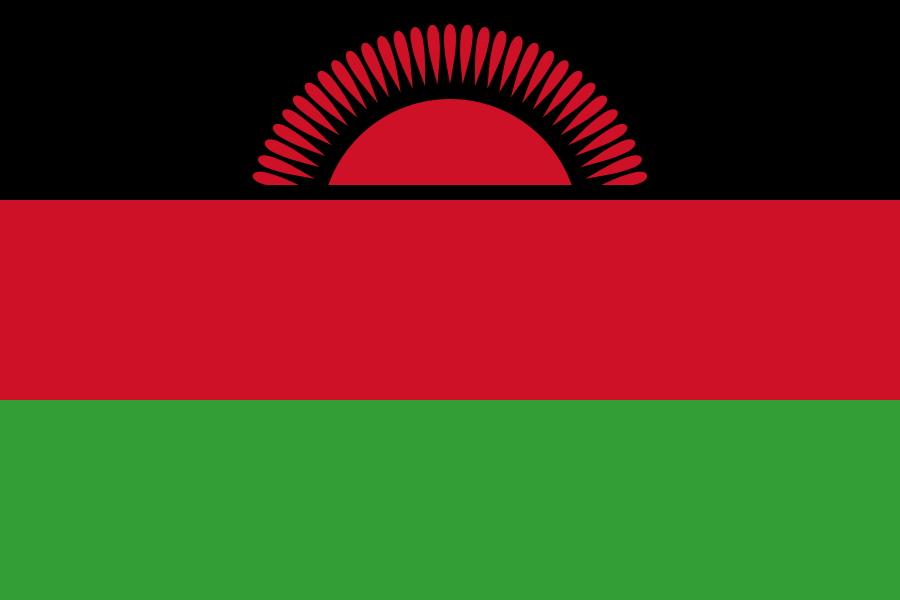
Malawi
  • Official Name: Republic of Malawi
  • Currency: MALAWIAN KWACHA (MWK)
  • Population: 21,655,286
  • Official Name: Republic of Malawi+
  • Currency: MALAWIAN KWACHA (MWK)++
  • Population: 21,655,286+++

Malawi's legal system is a hybrid of English common law, customary law, and statutory law. The country has a democratic, multiparty framework, but faces challenges with corruption and human rights, despite recent judicial reforms aimed at bolstering independence and accountability.

Malawi remains in debt distress. At about 88 percent of GDP, the country’s public debt is unsustainable, and its arrears on commercial debt stood at over USD 600 million in 2024. With revenues remaining suppressed and the fiscal deficit expected to reach 9.5 percent of GDP for the budget period 2025-26, the debt position will remain under pressure. Further, in the absence of a debt restructuring agreement with major commercial creditors amid a weaker local currency, non-payment risks will persist over the coming year.

The foreign exchange market in Malawi is volatile. The country experiences extended periods of hard currency scarcity during which foreign exchange transactions cannot be immediately cleared. This has led to shortages of critical goods, such as fuel and agricultural fertilisers, as foreign exchange reserves stand below one month of import cover. While authorities devalued the local currency to alleviate exchange pressures, convertibility challenges continue to persist.

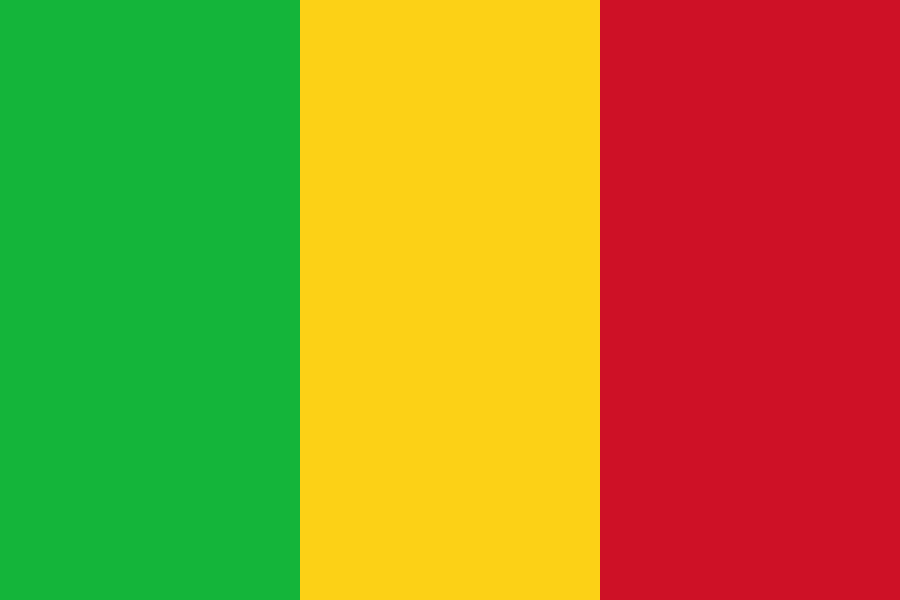
Mali
  • Official Name: Republic of Mali
  • Currency: WEST AFRICAN CFA FRANC (XOF)
  • Population: 24,478,595
  • Official Name: Republic of Mali+
  • Currency: WEST AFRICAN CFA FRANC (XOF)++
  • Population: 24,478,595+++

Mali's legal system is a hybrid of French civil law and customary law, but its formal legal institutions are currently overshadowed by transitional military rule, which has led to significant political instability and human rights issues. The formal justice system, hampered by corruption, resource limitations, and a lack of independence, often struggles to enforce the law and court rulings. In rural areas, many citizens rely on customary and religious justice mechanisms, which are often perceived as more accessible and less corrupt.

While increasing mining revenues have improved Mali’s 12-month fiscal outlook, the projected fiscal deficit for 2025 remains considerable. A reliance on more expensive regional debt, coupled with falling foreign investment, reduced international financial support, and rising security expenditures are likely to undermine the government’s ability to meet its financial obligations. Delays in payments to contractors, suppliers, and even civil servants are possible, as the government prioritises military spending over other commitments, further undermining economic stability.

While Mali remains a member of the West African Economic and Monetary Union (WAEMU) despite its exit from ECOWAS, concerns over currency inconvertibility and non-transfer risks persist. The CFA Franc's peg to the euro provides some stability. Still, the broader economic pressures and potential for further political isolation increase the risk of restrictions on capital flows and currency conversion. Should Mali consider leaving WAEMU, which is currently unlikely, the impact would be severe, leading to increased external vulnerability and challenges in repatriating profits, particularly for foreign businesses.

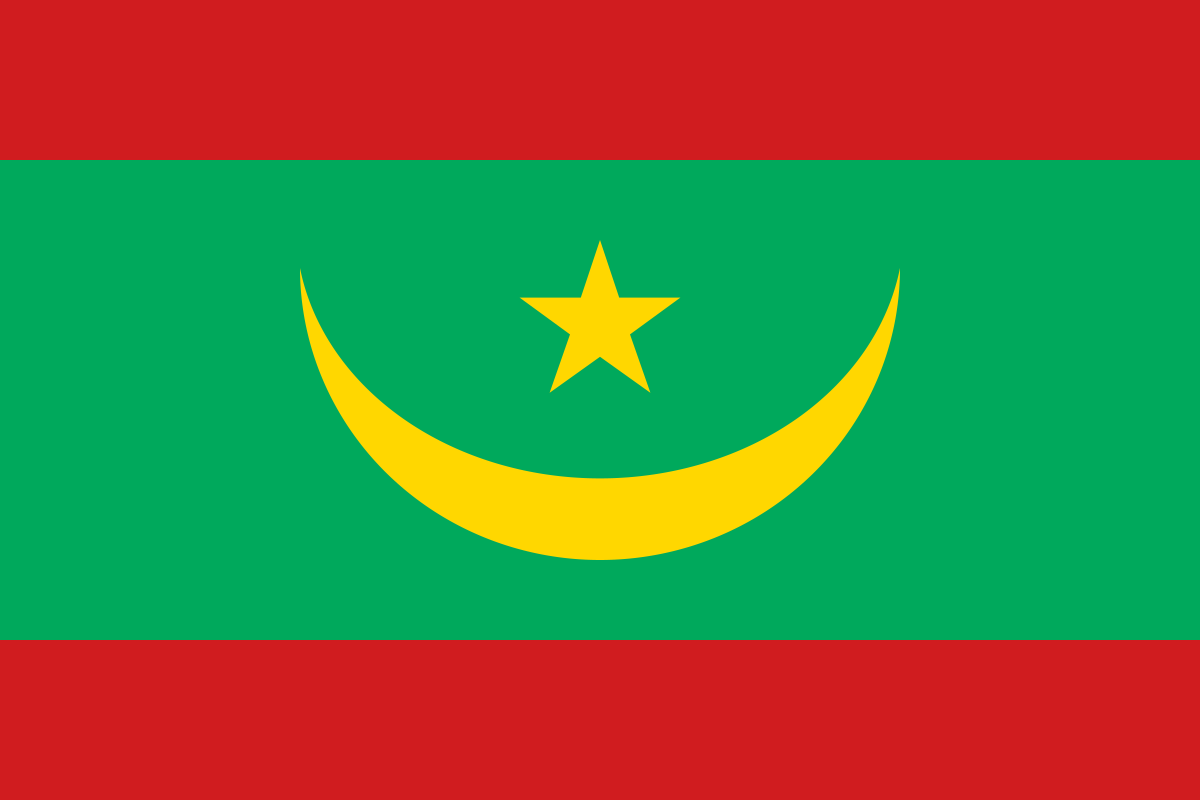
Mauritania
  • Official Name: Islamic Republic of Mauritania
  • Currency: MAURITANIAN OUGUIYA (MRU)
  • Population: 5,169,395
  • Official Name: Islamic Republic of Mauritania+
  • Currency: MAURITANIAN OUGUIYA (MRU)++
  • Population: 5,169,395+++

Mauritania's legal system is a hybrid of French civil law and Sharia (Islamic law), but it is heavily influenced by the government. While the constitution technically guarantees judicial independence, in practice, the judiciary is subject to political influence. Sharia, a key source of law, is formally incorporated into legislation but its interpretation and application vary. Significant human rights concerns and institutional weaknesses characterize the system.

Payment risks will remain moderate, as early gas revenues provide fiscal relief and strengthen reserves. Debt servicing obligations are expected to increase through 2026, but multilateral financing and cautious fiscal policy will support repayment schedules. The likelihood of sovereign default in the next year remains low. However, liquidity pressures could emerge if commodity prices soften or gas export volumes are disrupted. Contractors may face delayed disbursements in such scenarios, but sovereign obligations will likely continue to be prioritised and met.

Currency inconvertibility and transfer restrictions are not expected within the next twelve months. Adequate reserves and exchange rate stability will support continued access to foreign currency. The central bank will maintain a predictable framework for monetary operations, limiting volatility in convertibility. Temporary administrative delays in foreign exchange access may occur during periods of high demand, but no systemic restrictions will likely be imposed. Profit repatriation by foreign investors will continue, maintaining confidence in Mauritania’s transfer regime through 2026.

Mauritius
  • Official Name: Republic of Mauritius
  • Currency: MAURITIAN RUPEE (MUR)
  • Population: 1,259,509
  • Official Name: Republic of Mauritius+
  • Currency: MAURITIAN RUPEE (MUR)++
  • Population: 1,259,509+++

Mauritius has a hybrid legal system that combines French civil law with English common law, a legacy of its history as a colony of both nations. A distinctive feature is that while substantive law is often based on the French Napoleonic Code, procedural laws for both civil and criminal cases follow British practice. The country also retains the Judicial Committee of the Privy Council in London as its final court of appeal.

Following a recent audit of Mauritius’ public finances, the new administration revealed that public sector debt stood higher than previous estimates at 83.4 percent of GDP in June 2024. With a wider budget deficit now projected for the current 2024-25 fiscal year, debt is expected to rise further to 84.5 percent of GDP. While this is higher than the national debt ceiling of 80 percent, Mauritius maintains the ability to fulfil its debt obligations, supported by robust economic activity and a debt profile dominated in local currency.

Mauritius offers an attractive foreign currency environment, with no restrictions on foreign exchange. However, in practice, fluctuations in the value of the Mauritian rupee occasionally trigger hard currency shortages, which contribute to convertibility challenges. The new central bank chief has committed to addressing foreign currency liquidity shortages after the impact of interventions under the previous administration did not sufficiently address the shortfall. Foreign exchange scarcity will likely be alleviated by the influx of tourism revenues and investment over the coming year.

Morocco
  • Official Name: Kingdom of Morocco
  • Currency: MOROCCAN DIRHAM (MAD)
  • Population: 38,081,173
  • Official Name: Kingdom of Morocco+
  • Currency: MOROCCAN DIRHAM (MAD)++
  • Population: 38,081,173+++

Morocco's legal system is a hybrid civil law system with strong roots in French tradition, but with Islamic law (Sharia) significantly influencing family and inheritance matters. The judiciary includes general jurisdiction courts and specialized courts, with the Supreme Court serving as the final court of appeal. Key sources of law are the Constitution, royal decrees, and laws passed by Parliament.

Morocco retains sound creditworthiness supported by precautionary financing lines, Eurobond access, and robust reserves. Debt servicing remains sustainable under current fiscal parameters. Sovereign ratings remain stable, and external borrowing conditions continue to provide liquidity. Elevated public debt constrains policy flexibility but does not threaten repayment ability. The authorities maintain active debt management to mitigate refinancing exposure. Non-payment risk remains contained, reflecting prudent fiscal coordination and reliable access to multilateral and market-based funding sources.

The managed exchange regime continues to operate effectively, with sufficient reserves to cover import and transfer obligations. The Office des Changes has eased certain outward payment rules, reflecting administrative confidence in foreign-currency availability. Profit repatriation and current-account transfers remain permitted under standard documentation. No restrictions have been introduced, and convertibility conditions remain predictable. The financial system demonstrates liquidity stability, ensuring that foreign investors can conduct cross-border transactions without operational barriers or transfer delays.

Mozambique
  • Official Name: Republic of Mozambique
  • Currency: MOZAMBICAN METICAL (MZN)
  • Population: 34,631,766
  • Official Name: Republic of Mozambique+
  • Currency: MOZAMBICAN METICAL (MZN)++
  • Population: 34,631,766+++

Mozambique's legal system is a hybrid of Portuguese civil law and customary law. The foundation of the legal framework is the 2004 Constitution, which recognizes the co-existence of different normative and dispute-resolution systems, as long as they are not contrary to its fundamental principles.

Mozambique’s non-payment risks persist amid weak revenue performance and rising debt servicing costs. About 41 percent of public debt is held domestically, primarily in costly, short-term instruments. In 2024, the government temporarily halted payments to Rwanda for its troop deployment in Cabo Delgado, highlighting fiscal liquidity challenges. Despite ongoing IMF negotiations, liquidity constraints persist, and short-term financing pressures are expected to heighten the risk of payment delays to service providers over the coming year.

Since the introduction of new currency controls in 2024, businesses in Mozambique have increasingly noted greater difficulty in obtaining forex. Additionally, some foreign exchange barriers remain in place, including a minimum USD 130,000 capital requirement for foreign investors to repatriate profits and invested capital. In early 2025, the government imposed further regulations requiring businesses to convert 50 percent of export earnings to local currency to boost foreign exchange liquidity, although shortages persist.

Namibia
  • Official Name: Republic of Namibia
  • Currency: NAMIBIAN DOLLAR (NAD)
  • Population: 3,030,131
  • Official Name: Republic of Namibia+
  • Currency: NAMIBIAN DOLLAR (NAD)++
  • Population: 3,030,131+++

Namibia's legal system is a stable hybrid of Roman-Dutch common law, English common law, and customary law. The legal framework is defined by the 1990 Constitution, which establishes the rule of law and guarantees fundamental rights and freedoms.

While Namibia continues to attract foreign investment inflows for critical minerals projects, the slow realisation of new revenues will sustain fiscal pressures in the short term, with the public debt-to-GDP ratio projected to remain above 60 percent in 2025. However, non-payment risk will largely be mitigated by proactive management of major debt repayments and fiscal prudence. Namibia plans to settle a USD 750 million Eurobond in October 2025, pivoting towards domestic debt over external instruments.

Namibia does not have any major restrictions on foreign exchange and investment repatriation. The country has continued to maintain foreign reserve levels above the three-month import cover benchmark, supporting stability in the value of the Namibian dollar and ensuring currency liquidity in the domestic market. Despite its persistent current account deficit, CINT risk will remain abated in the country.

Niger
  • Official Name: Republic of Niger
  • Currency: WEST AFRICAN CFA FRANC (XOF)
  • Population: 27,032,412
  • Official Name: Republic of Niger+
  • Currency: WEST AFRICAN CFA FRANC (XOF)++
  • Population: 27,032,412+++

Niger's legal system is based on the French civil law tradition, with influence from Islamic and customary law. A new constitution was approved in 2010, establishing a republic with a semi-presidential system of government. However, the legal framework has been severely undermined since the 2023 military coup, which suspended the constitution and dissolved government institutions.

Niger faces acute non-payment risks driven by the economic fallout from its political instability. Following the July 2023 coup, Niger has defaulted on USD 520 million in debt payments due to regional sanctions that cut off access to financial markets. The risk is compounded by disruption to oil exports and the mining sector, depriving the country of critical revenues needed for debt servicing. The military junta has struggled to meet its financial obligations, and the inability to access international credit markets continues to undermine its fiscal capacity.

Currency inconvertibility and non-transfer risks in Niger are heightened by ongoing political instability and sanctions. The suspension from the regional financial market has restricted the military government's ability to convert the West African CFA franc into foreign currencies. Additionally, the deteriorating political and security situation has led to a sharp decline in foreign investment, further limiting the availability of foreign currency. Security-related disruptions to the Niger-Benin oil pipeline, a vital source of foreign exchange, will compound these challenges, leaving the country increasingly isolated financially and vulnerable to currency-related risks.

Nigeria
  • Official Name: Federal Republic of Nigeria
  • Currency: NIGERIAN NAIRA (NGN)
  • Population: 232,679,478
  • Official Name: Federal Republic of Nigeria+
  • Currency: NIGERIAN NAIRA (NGN)++
  • Population: 232,679,478 +++

Nigeria's legal system is a complex hybrid of English common law, customary law, and Sharia law, reflecting the country's colonial history and diverse cultures and religions. The legal framework is established by the 1999 Constitution, which serves as the supreme law of the land.

Improved revenue collection over 2025 has strengthened the government’s fiscal position, reducing the need for domestic borrowing. However, external debt servicing costs are set to increase substantially in the coming year in light of an accelerated borrowing campaign. This will greatly increase exposure to exchange rate fluctuations and oil price volatility, sustaining non-payment risks. Non-payment risks will also remain persistent in state-owned enterprises, including in the oil and gas sector.

Exchange rate liberalisation under Tinubu’s government has eased currency pressures, but structural forex shortages will likely persist. Nigeria’s foreign exchange reserves have recovered substantially since mid-2025, in part due to reforms aimed at reducing fuel imports and the stabilisation of the naira. However, given external debt servicing costs, future shocks have high potential to once again exacerbate forex liquidity constraints and intensify challenges faced by foreign firms in repatriating earnings.

Republic of the Congo
  • Official Name: Republic of the Congo
  • Currency: CENTRAL AFRICAN CFA FRANC (XAF)
  • Population: 6,332,961
  • Official Name: Republic of the Congo+
  • Currency: CENTRAL AFRICAN CFA FRANC (XAF)++
  • Population: 6,332,961+++

The Republic of the Congo's legal system is based on French civil law and customary law. While its Constitution guarantees judicial independence, political influence and widespread corruption significantly undermine the rule of law. The country adopted a new constitution in 2015 that extends the presidential term limits and provides complete immunity to former presidents.

Non-payment risks are rising, as the government faces mounting debt servicing obligations into 2026. Alongside falling oil revenues and dwindling foreign exchange reserves, the expiry of an IMF programme at the start of 2025 will increase fiscal pressures, as there are few signs that the government will seek a new financing arrangement imminently. A local currency-denominated debt swap operation in late 2024 highlighted the government’s limited capacity to make debt repayments and undermined the availability of financing via regional capital markets.

There are currently no formal restrictions on the transfer of funds. However, financial instability linked to high debt levels, low foreign reserves, and fiscal constraints could impact access to foreign currency. Occasional foreign exchange shortages may arise from administrative inefficiencies and economic pressures, affecting business operations, including in the form of delayed payments. Regulatory attention to cryptocurrency may also affect digital transactions.

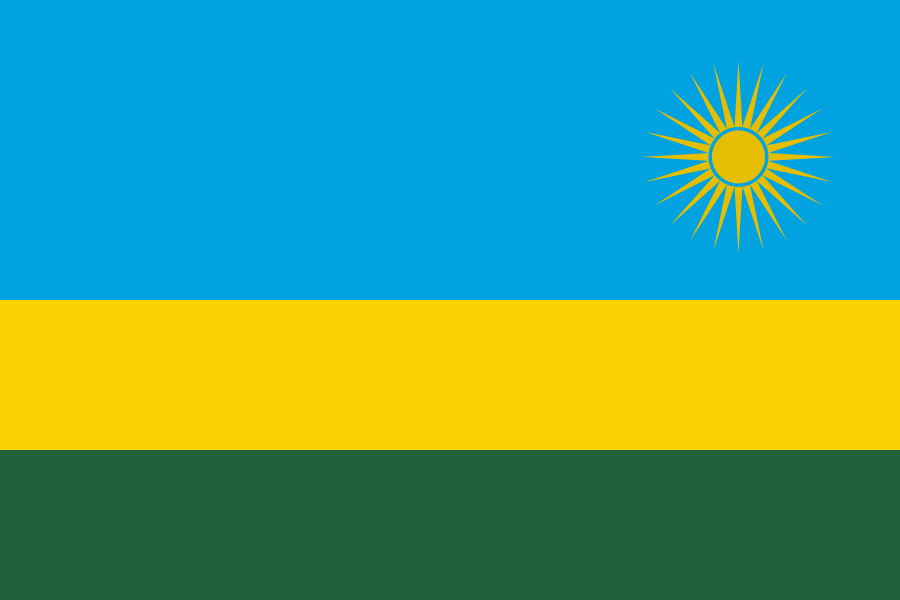
Rwanda
  • Official Name: Republic of Rwanda
  • Currency: RWANDAN FRANC (RWF)
  • Population: 14,256,567
  • Official Name: Republic of Rwanda+
  • Currency: RWANDAN FRANC (RWF)++
  • Population: 14,256,567+++

Rwanda's legal system is a hybrid that combines French civil law with common law principles. This system operates alongside customary law and was significantly reformed following the 1994 genocide. The legal framework is defined by the 2003 Constitution, which has been amended several times, most recently in 2023.

Rwanda’s stood at around 67 percent of GDP in 2024. However, most of the country’s external debt has been contracted on fixed-rate terms, which reduces its vulnerability to surges in global interest rates, while keeping debt servicing costs at bay. Going forward, Rwanda’s involvement in the eastern DRC threatens its good relations with multilateral and external development partners, raising concerns about the country’s access to concessional funding, which may contribute to non-payment risk in the medium term.

Rwanda has a liberalised foreign exchange rate, and the central bank maintains foreign reserves of at least four months of import cover to ensure liquidity in the domestic market. However, the country’s persistent trade deficit intermittently gives rise to hard currency shortages, which may result in delayed payments from the government for imported goods. Despite authorities' efforts to intervene, pressure on the currency exchange market is likely to remain over the coming year, due to the structural trade deficit.

Senegal
  • Official Name: Republic of Senegal
  • Currency: WEST AFRICAN CFA FRANC (XOF)
  • Population: 18,501,984
  • Official Name: Republic of Senegal+
  • Currency: WEST AFRICAN CFA FRANC (XOF)++
  • Population: 18,501,984+++

Senegal's legal system is a hybrid of French civil law and customary law, established by its Constitution and influenced by its membership in regional bodies like OHADA. While known for political stability, its judiciary faces challenges related to independence and efficiency.

The risk of non-payment will continue to rise in the wake of an audit of Senegal’s public finances, which revealed that the country’s debt situation is more precarious than previously understood. Debt servicing costs are particularly pronounced until 2028, while hydrocarbon revenues will remain marginal for several years. Credit rating downgrades in 2025 will further exacerbate this situation, raising the cost of borrowing and forcing the government to take on more expensive domestic debt. Negotiations over a new IMF programme are delayed, exacerbating near-term pressures.

Senegal’s use of the CFA Franc currency offers France’s guarantee of convertibility, fixed parities with the euro, free transferability, and the centralisation of foreign exchange reserves. However, the new government has indicated its support for reforms, advocating a flexible currency pegged to at least two currencies to help absorb shocks and support export competitiveness. However, while the new government has indicated an intent to abandon the CFA franc, it remains unlikely that this will come about.

Sierra Leone
  • Official Name: Republic of Sierra Leone
  • Currency: SIERRA LEONEAN LEONE (SLL)
  • Population: 8,642,022
  • Official Name: Republic of Sierra Leone+
  • Currency: SIERRA LEONEAN LEONE (SLL)++
  • Population: 8,642,022+++

Sierra Leone's legal system is a hybrid of English common law, statutory law, and customary law, reflecting its history as a former British colony. The system has undergone significant reform since the end of the civil war in 2002. The country's 1991 Constitution is the supreme law, providing for the separation of powers between the executive, legislative, and judicial branches.

Non-payment risks in Sierra Leone are rising, as the government attempts to finance a mounting deficit. The government and state agencies have accumulated arrears in trade and infrastructure projects, and delays in payment to contractors have caused operational disruptions. While the government secured a new IMF programme in 2024, disbursements have been delayed over the first half of 2025. The suspension of IMF support would substantially increase non-payment risks, given rising expenditure, debt servicing costs, and challenges in raising revenues.

The country faces substantial fiscal pressures, with a high debt burden and ongoing economic difficulties that could impact foreign exchange availability. The local currency has depreciated significantly in recent years. Foreign exchange reserves have fallen to a critical point as anticipated IMF disbursements did not materialise in the first half of 2025. Severe currency shortages have previously led to temporary restrictions on foreign exchange transactions. There is potential for reinstatement of such restrictions if the fiscal situation deteriorates further.

South Africa
  • Official Name: Republic of South Africa
  • Currency: SOUTH AFRICAN RAND (ZAR)
  • Population: 64,007,187
  • Official Name: Republic of South Africa+
  • Currency: SOUTH AFRICAN RAND (ZAR)++
  • Population: 64,007,187+++

South Africa's legal system is a stable hybrid of Roman-Dutch common law, English common law, customary law, and a mix of religious personal laws. The country's legal landscape was fundamentally transformed by the 1996 Constitution, which is the supreme law and includes an extensive Bill of Rights. This constitutional supremacy replaced a system based on parliamentary sovereignty during the apartheid era.

The risk of non-payment is influenced by the country’s weak fiscal position, characterised by high debt levels and slow economic growth. The GNU’s commitment to fiscal consolidation may mitigate some risks, but pressures on public finances remain. The government recently abandoned plans to increase the VAT rate, which has widened the financing gap in the latest budget. Despite this, the government still expects the debt-to-GDP ratio to peak at 77.4 percent of GDP in the 2025/26 fiscal year before gradually declining thereafter.

CINT risks are largely mitigated by the government's established policies on currency convertibility and capital transfers. However, ongoing economic challenges and the strict enforcement of exchange control regulations by the South African Reserve Bank (SARB) could create potential obstacles, particularly for large cross-border transactions. Recent updates to exchange control regulations have reinforced the SARB's authority to enforce compliance, impacting the ease with which businesses transfer funds abroad. Although outright restrictions are unlikely, delays and compliance requirements are expected to persist.

Sudan
  • Official Name: Republic of the Sudan
  • Currency: SUDANESE POUND (SDG)
  • Population: 50,448,963
  • Official Name: Republic of the Sudan+
  • Currency: SUDANESE POUND (SDG)++
  • Population: 50,448,963+++

Sudan's legal system is in a state of crisis due to the ongoing conflict that erupted in April 2023. The war between the Sudanese Armed Forces (SAF) and the paramilitary Rapid Support Forces (RSF) has severely damaged the justice system, creating a climate of impunity where human rights abuses are widespread and accountability is lacking.

Fiscal revenues are expected to remain depressed, leaving public salary arrears unresolved and supplier invoices unpaid. The Central Bank operates with limited reserves and intermittent electronic systems, delaying the settlement of import letters of credit. SAF procurement officials will prioritise fuel and munitions, deferring civil obligations, while RSF disbursements rely on fluctuating gold sales. Commercial lenders are unlikely to extend new credit, raising default risk across domestic value chains.

Hard currency scarcity is projected to intensify as export receipts decline and informal remittance channels become increasingly dominant. Divergent exchange rates will persist, with the parallel market exceeding the official quotation by more than 40 percent. Banking outages in Khartoum and Port Sudan hinder electronic transfers, compelling businesses to transport cash that is exposed to confiscation at checkpoints. New banknote issuance may fail to restore confidence, and rival authorities could impose separate currency systems, complicating repatriation of dividends and cross-border supplier payments.

Tanzania
  • Official Name: United Republic of Tanzania
  • Currency: TANZANIAN SHILLING (TZS)
  • Population: 68,560,157
  • Official Name: United Republic of Tanzania+
  • Currency: TANZANIAN SHILLING (TZS)++
  • Population: 68,560,157+++

Tanzania's legal system is a hybrid of English common law, customary law, and Islamic law. The legal landscape is complicated by the country's union between mainland Tanganyika and the autonomous islands of Zanzibar, each with its own parallel judicial structure for non-union matters. The 1977 Constitution is the supreme law of the land.

Despite accumulating commercial debt to fund major public infrastructure projects, Tanzania’s debt-to-GDP ratio remains contained, mitigating non-payment risks. However, debt servicing is set to consume about one-third of total spending in the 2025-26 fiscal year, and an increased shift towards domestic debt instruments will reduce pressure on the fiscal position going forward.

The recent interventions by the central bank and the authorities’ commitment to enhancing the flexibility of the exchange rate have contributed to alleviating foreign exchange shortages in recent months. This has eased CINT challenges experienced since 2022. The rise in tourism revenues and a sustained influx of foreign direct investment also continue to support government reserves.

Togo
  • Official Name: Togolese Republic
  • Currency: WEST AFRICAN CFA FRANC (XOF)
  • Population: 9,515,236
  • Official Name: Togolese Republic+
  • Currency: WEST AFRICAN CFA FRANC (XOF)++
  • Population: 9,515,236+++

The legal system of Togo is a mixed system combining French civil law, inherited from its colonial past, with customary law. Recent political events, including a controversial constitutional overhaul in 2024, have significantly impacted the country's governance and legal framework.

Debt servicing costs will continue to weigh heavily on Togo’s budget in the near-term, as the government has relied on more expensive financing from regional currency markets to meet budgetary shortfalls in recent years. However, the debt situation is expected to improve into 2025 and 2026, as the government shifts to incorporate a greater proportion of external loans and concessional budget support from multilateral partners. Coupled with current economic growth projections, this will likely stabilise the debt situation over the coming years.

As a member of the West African Economic and Monetary Union (WAEMU), Togo shares a common currency (the CFA franc), which is pegged to the euro. The CFA Franc currency offers France’s guarantee of convertibility, although the regional bank’s control over the movement of foreign currency occasionally results in foreign exchange liquidity challenges. Additionally, the transfer of more than CFA franc 500,000 (under USD 1,000) to countries outside the West Africa franc zone and France requires additional documentation.

Tunisia
  • Official Name: Tunisian Republic
  • Currency: TUNISIAN DINAR (TND)
  • Population: 12,277,109
  • Official Name: Tunisian Republic+
  • Currency: TUNISIAN DINAR (TND)++
  • Population: 12,277,109+++

Tunisia's legal system blends French civil law with Islamic legal concepts, and has a unified judicial structure with civil, criminal, and administrative branches. Recent years have seen concerns about a deterioration in the rule of law, with increased executive influence over the judiciary and a crackdown on legal professionals. Key national legislation is published in the official gazette, and while the legal framework includes provisions for civil liberties, the new 2022 constitution removed some previously existing checks and balances on executive power.

Tunisia’s external debt repayments, totalling approximately USD 3.3 billion through 2026, continue to pressure public finances. The absence of IMF support has shifted the burden to domestic borrowing and central bank financing. As a result, suppliers in the infrastructure and healthcare sectors report delayed payments. International creditors remain cautious amid fiscal uncertainty, limiting Tunisia’s access to new debt instruments. Domestic arrears continue to accumulate. Payment strains persist amid deteriorating liquidity, increasing the likelihood of additional delays to public and private creditors throughout the year.

Tunisia maintains strict foreign exchange restrictions. Import payments require bank verification of shipping documentation, and access to foreign currency is limited. Profit repatriation is often delayed due to administrative review processes. The Central Bank retains the authority to impose transaction controls when reserves fall below critical thresholds. Amendments proposed in 2025 to liberalise currency rules have failed to advance. Businesses report difficulties in currency procurement. The continued enforcement of onerous procedures impedes trade and foreign investment, sustaining currency inconvertibility risk throughout the forecast period.

Uganda
  • Official Name: Republic of Uganda
  • Currency: UGANDAN SHILLING (UGX)
  • Population: 50,015,092
  • Official Name: Republic of Uganda+
  • Currency: UGANDAN SHILLING (UGX)++
  • Population: 50,015,092+++

Uganda's legal system is a hybrid of English common law, statutory law, and customary law. While the 1995 Constitution guarantees judicial independence, the justice system is marred by significant challenges, including political interference, corruption, and a persistent disregard for human rights.

In recent years, public debt has stabilised at about 50 percent of GDP. Given high interest rates, the Bank of Uganda estimates that external debt servicing costs will account for 30 percent of spending in the financial year 2025-26. However, the country’s debt is considered sustainable, mitigating non-payment risks. This position is bolstered by the resumption of World Bank funding in 2025 and renewed engagement with the IMF for a new programme.

The foreign exchange system is generally accommodating of foreign investment. Investors can obtain foreign exchange from commercial banks and carry out transfers in and out of the country relatively freely. Authorities continue to maintain sufficient foreign exchange reserves (above three months of import cover) to ensure hard currency liquidity in the domestic market. An influx of foreign direct investment for infrastructure and oil developments will further support liquidity in the coming months.

Zambia
  • Official Name: Republic of Zambia
  • Currency: ZAMBIAN KWACHA (ZMW)
  • Population: 21,314,956
  • Official Name: Republic of Zambia+
  • Currency: ZAMBIAN KWACHA (ZMW)++
  • Population: 21,314,956+++

Zambia's legal system is a dual system that combines English common law and customary law. The 1991 Constitution, as amended, is the supreme law, establishing a multiparty democracy and a judiciary that is intended to be independent.

Non-payment risk in Zambia is reflected by the government’s debt default in 2020. Hichilema’s government has been proactive and transparent as it continues to work through the restructuring of the country's debt, which stood at 114 percent of GDP in end-2024. After reaching agreements with bondholders, non-payment risk will persist as the government navigates debt restructuring negotiations with its commercial creditors in the coming months.

There are no major restrictions on foreign exchange transactions, apart from an over-the-counter cash transaction limit of USD 5,000 per day. However, the depreciation of the local currency, the kwacha, has adversely impacted the availability of hard currency in recent years. Currency inconvertibility challenges may resurface over the coming year, as the kwacha is expected to continue to lose value against major currencies.

Zimbabwe
  • Official Name: Republic of Zimbabwe
  • Currency: ZIMBABWEAN DOLLAR (ZWL)
  • Population: 16,634,373
  • Official Name: Republic of Zimbabwe+
  • Currency: ZIMBABWEAN DOLLAR (ZWL)++
  • Population: 16,634,373+++

Zimbabwe's legal system is a hybrid that combines Roman-Dutch law, English common law, statutory law, and customary law. The supreme law is the 2013 Constitution, which includes a comprehensive Bill of Rights. However, government interference, corruption, and a lack of accountability for security forces significantly undermine the rule of law and human rights protections.

Zimbabwe’s total public debt stands at 97 percent of GDP, presenting substantial non-payment risks. Authorities are seeking USD 2.6 billion in bridge financing to clear arrears with multilateral lenders and pave the way for debt restructuring. Meanwhile, since the onset of 2025, the government has not paid platinum producers for their exports in local currency, with outstanding payments estimated to be worth millions of US dollars.

The foreign exchange shortage in Zimbabwe presents challenges for international firms when repatriating profits and trading in goods. As part of efforts to increase foreign exchange reserves, the government imposed a standardised foreign currency retention system in which traders must convert at least 25 percent of their export revenue into local currency at the official interbank market rate. There is also an increased risk of the government increasing the retention requirement with minimal warning during times of economic downturn.

Our local teams

Mohamed Salah

Algeria

Mohamed Salah 
Algeria

Ana

Angola

Ana 
Angola

Andre

Benin

Andre 
Benin

Yvette

Burkina Faso

Yvette 
Burkina Faso

Joel

Cameroon
Joel 
Cameroon

Clandia

Cap Verde

Clandia 
Cap Verde

Antonie

Congo DRC

Antonie 
Congo DRC

Ahmed

Djibouti

Ahmed  
Djibouti

Ahmed

Egypt - Cairo

Ahmed 
Egypt - Cairo

Parfa

Equatorial Guinea

Parfa 
Equatorial Guinea

Nafkot

Ethiopia

Nafkot 
Ethiopia

Guy Darren

Gabon

Guy Darren  
Gabon

Lawrence

Gambia

Lawrence 
Gambia

Gabriel Ofori

Ghana

Gabriel Ofori 
Ghana

Alpha

Guinea

Alpha 
Guinea

Fausprost Agnero

Ivory Coast

Fausprost Agnero 
Ivory Coast

Joseph Mutemi

Kenya - Mombasa

Joseph Mutemi 
Kenya - Mombasa

Josphat

Kenya - Nairobi

Josphat 
Kenya - Nairobi

Oloishorua

Kenya

Oloishorua 
Kenya

Gertruud

Madagascar

Gertruud 
Madagascar

Gift

Malawi

Gift 
Malawi

Ogo

Mali

Ogo 
Mali

Ahmed Taleb

Mauritania

Ahmed Taleb  
Mauritania

Navish

Mauritius

Navish 
Mauritius

Serrafi

Morocco

Serrafi 
Morocco

Douglas

Mozambique

Douglas 
Mozambique

Abdelkader

Niger
Abdelkader 
Niger

Bashir

Nigeria - Abuja

Bashir 
Nigeria - Abuja

Danladi

Nigeria - Lagos

Danladi 
Nigeria - Lagos

Elokobi

Rwanda

Elokobi 
Rwanda

Djibril

Senegal

Djibril 
Senegal

Linda

South Africa - Cape Town

Linda 
South Africa - Cape Town

Ruwayda

South Africa - Johannesburg

Ruwayda 
South Africa - Johannesburg

Lusekelo

Tanzania

Lusekelo 
Tanzania

Eric

Togo

Eric 
Togo

Essra

Tunisia

Essra 
Tunisia

John

Uganda

John 
Uganda

Ronald

Zambia

Ronald 
Zambia

Tembalami

Zimbabwe

Tembalami 
Zimbabwe
Our boots on
the ground

Our local teams operate with a ‘boots on the ground’ mindset, ensuring that every case receives dedicated, in-region attention. Our specialists understand local laws, business practices, and cultural dynamics. This enables fast, effective, and transparent claims resolution tailored to each market.

Discover our services

News

Tanzania’s Smart Solution for Disputes

Arbitration has become a vital alternative dispute resolution (ADR) mechanism in Tanzania, providing a swift, private, and economical method for settling disagreements outside the formal court system. It is governed by the Arbitration Act and the Civil Procedure Code. This process is increasingly...

Read article
All news

Supporting African Creativity

Read more

Debt recovery in Africa

Read more
letter s.

Contact us

Let’s talk solutions.

How can we help you? Reach out today and experience service that’s fast, straightforward, and effective.

Get in touch